جدول المحتويات
مقدمة
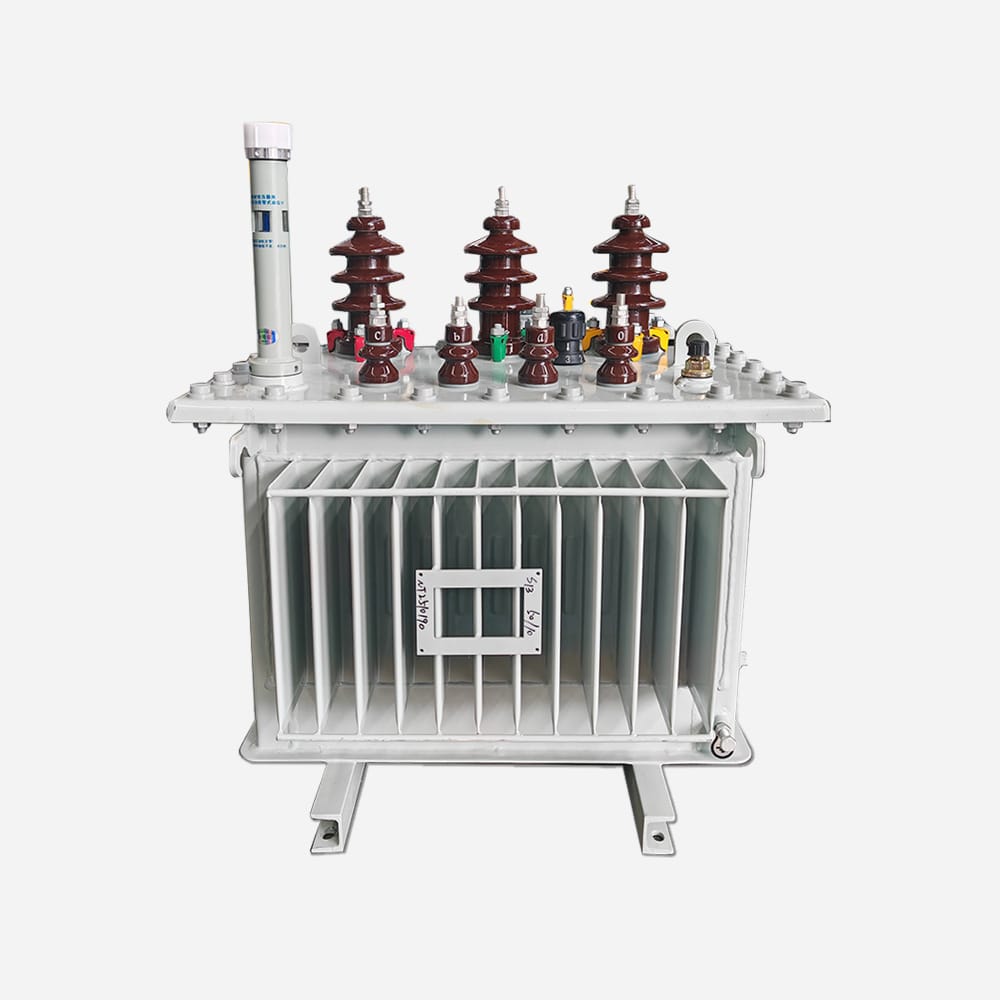
Selecting the appropriate three phase oil immersed transformer is one of the most consequential decisions in any industrial power distribution project. These robust machines form the backbone of electrical infrastructure worldwide, stepping down high-voltage electricity from transmission networks to usable levels for factories, commercial facilities, and utility distribution systems.
An ill-suited transformer doesn’t just underperform—it generates excessive energy losses, requires frequent maintenance, and can jeopardize operational continuity. For plant managers, electrical engineers, and procurement specialists, understanding the nuances of oil immersed transformer technology translates directly into measurable cost savings and system reliability.
This comprehensive guide covers everything you need to know about three phase oil immersed transformers: from core technical parameters and selection criteria to pricing factors and manufacturer evaluation. Whether you’re sourcing a power transformer for a new facility or replacing aging equipment, this article provides the actionable insights industrial buyers demand.
What Is a Three Phase Oil Immersed Transformer?
A three phase oil immersed transformer is an electrical device that transfers electrical energy between two or more circuits through electromagnetic induction. Unlike dry-type transformers that rely on air for cooling, oil immersed transformers submerge the core and windings in insulating oil—a medium that serves dual purposes: cooling and electrical insulation.
The oil immersed transformer design enables superior heat dissipation, allowing these units to handle higher power densities within compact footprints. The insulating oil absorbs heat generated by core losses and winding resistance, then transfers it to the tank walls and external radiators for dissipation into the surrounding environment.
Key characteristics of three phase oil immersed transformers include:
- Higher efficiency: Typically achieving 98% or greater at full load
- Superior overload capability: Withstanding short-term peaks without damage
- عمر خدمة أطول: 25-40 years with proper maintenance
- Cost-effectiveness: Lower initial investment compared to equivalent dry-type units
- Environmental resilience: Performs reliably in harsh outdoor conditions
These transformers serve as distribution transformers stepping down medium voltage (11kV, 33kV) to utilization voltage (400V), or as power transformers in substation applications handling larger capacities.
Key Technical Parameters You Must Understand Before Choosing
Understanding these fundamental specifications ensures you specify equipment that matches your application requirements precisely.
Voltage Rating (11kV, 33kV, etc.)
The voltage rating defines the maximum operating voltage the transformer windings can sustain continuously. Common primary voltage ratings include:
- 6kV, 6.6kV: Industrial plant configurations
- 10kV, 11kV: Most common for distribution networks globally
- 33kV, 35kV: Heavy industrial and utility substation applications
Secondary voltages typically range from 0.4kV (400V) for direct utilization to 6.6kV or 10.5kV for cascading transformer arrangements. Always confirm your voltage requirements match the grid supply characteristics and downstream equipment specifications.
Power Capacity (kVA / MVA selection)
The kVA rating indicates the transformer’s apparent power handling capability. Selection depends on your total load calculation with appropriate margin for growth:
| Application Scale | Typical kVA Range |
|---|---|
| Small commercial / rural distribution | 30-200 kVA |
| Medium industrial facilities | 250-1000 kVA |
| المنشآت الصناعية الكبيرة | 1000-3150 kVA |
| Utility substations / renewable energy | Up to 5000+ kVA |
For capacities exceeding 5000 kVA, custom engineering solutions become necessary.
Efficiency and Load Losses
Efficiency directly impacts your operating costs over the transformer’s lifetime. Two loss categories define overall efficiency:
No-load losses (core losses): Constant energy consumption regardless of load, occurring due to magnetization of the core. These depend on core material quality—modern low-loss silicon steel or amorphous alloy cores dramatically reduce these losses.
Load losses (copper losses): Vary with the square of load current, caused by I²R resistance in windings. Quality of conductor material (copper versus aluminum) and winding design influence these losses significantly.
Modern three phase oil immersed transformers typically achieve:
- No-load losses: 0.2-0.3% of rated power
- Load losses: 0.5-1.5% of rated power
- Overall efficiency: ≥98% at full load
Higher efficiency units command premium pricing but deliver substantial savings across a 25+ year operational lifespan.
Cooling Method and Temperature Rise
Cooling classification follows IEC standards:
ONAN (زيت طبيعي هواء طبيعي): Passive cooling through natural oil circulation and radiation. Suitable for continuous operation at rated loads up to approximately 2000 kVA.
ONAF (قسر الهواء الطبيعي بالزيت): Temperature-controlled fans supplement natural cooling, enabling 120% nominal capacity for short durations. Ideal for 2000-6000 kVA units.
OFAF (Oil Forced Air Forced): Oil circulation pumps combined with forced-air fans optimize heat transfer for high-density applications above 6000 kVA or critical installations.
Temperature rise ratings (typically 55°C or 65°C for top oil) indicate thermal limits—the lower the rise rating, the more efficient the thermal design.
Understanding Transformer Types for Different Applications
Beyond standard three phase oil immersed transformers, several variants address specific operational requirements:
Hermetically sealed transformers: Eliminate conservator tanks, reducing oil oxidation and maintenance. Ideal for humid or polluted environments where moisture ingress concerns prevail.
Conservator-type transformers: Include expansion tanks with breathers, allowing oil thermal expansion while incorporating gas relays for fault detection.
Low-noise transformers: Feature specialized core designs (step-lap joints, noise-dampening tanks) for residential or commercial proximity installations, achieving sub-55dB operation.
Harmonic-resistant transformers (K-factor rated): Engineered for non-linear loads from variable frequency drives, UPS systems, or data center equipment. K-13 or K-19 ratings indicate progressively higher harmonic current tolerance.
How to Select the Right kVA Rating for Your Project
Correct kVA rating selection prevents both underperformance and unnecessary expense. Follow these systematic steps:
Load calculation basics
Calculate total connected load by summing all equipment power requirements (in kW), then divide by your anticipated power factor (typically 0.8-0.95):
Required kVA = Total Load (kW) ÷ Power Factor
Example: A facility with 800 kW connected load at 0.85 power factor requires approximately 941 kVA—standardize to the next common rating (1000 kVA).
Safety margin considerations
Apply appropriate margins based on load characteristics:
- Resistive loads only: 20-25% margin above calculated maximum
- Motor starting loads: 30-40% margin to accommodate inrush currents
- Harmonic-generating loads: Select K-rated transformers and consider 25-30% additional capacity
- Future expansion plans: Factor in planned capacity additions
Future expansion planning
Industry best practice recommends sizing transformers for 115-120% of current maximum demand, ensuring headroom for growth without requiring immediate replacement. For rapidly expanding facilities, consider whether modular additions or parallel transformer installations make more economic sense than oversizing a single unit.
Oil Immersed Transformer Efficiency and Performance Factors
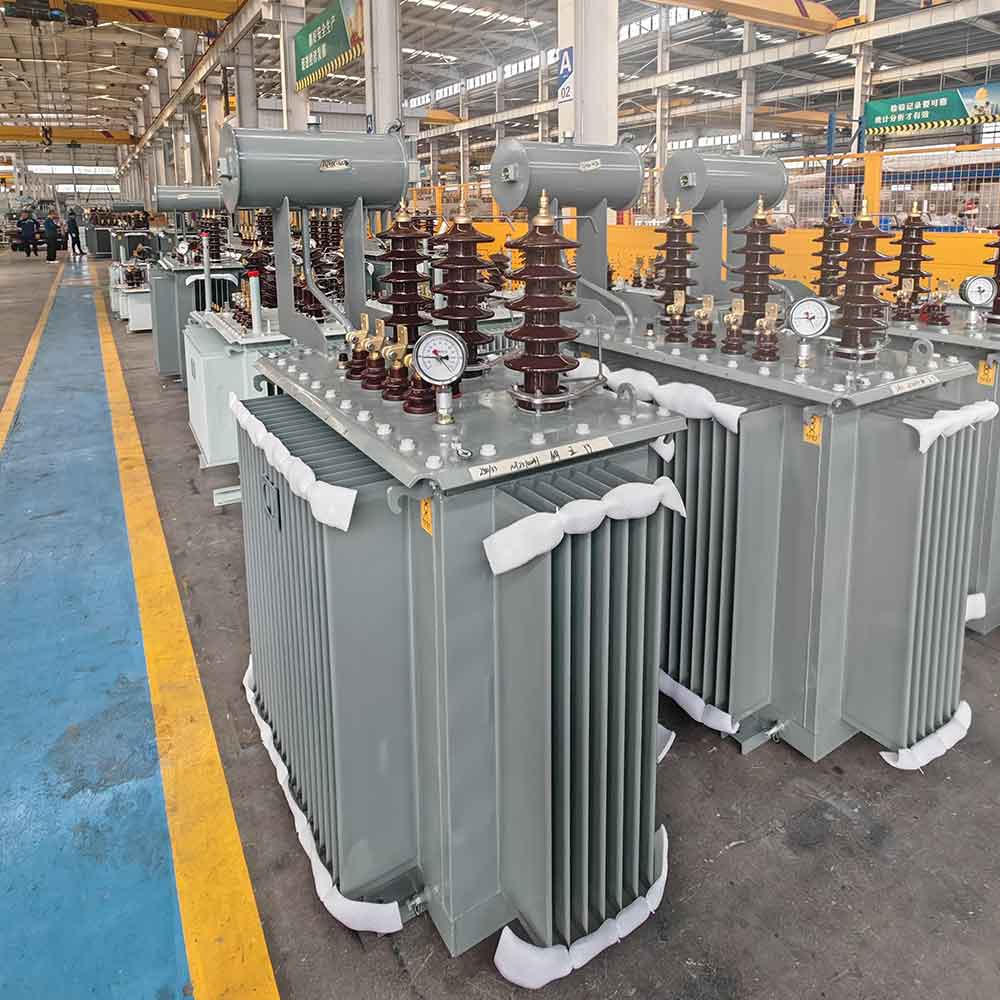
Beyond basic specifications, these performance factors differentiate transformer quality and long-term value:
Core materials: Cold-rolled grain-oriented (CRGO) silicon steel represents the standard, with laser-scribed or high-flux (HIB) grades offering further loss reductions. Amorphous alloy cores achieve 60-70% lower no-load losses but at premium cost.
Winding conductors: Copper windings provide superior conductivity and short-circuit withstand compared to aluminum, justifying higher material costs through reduced losses and improved reliability.
Insulation systems: Oil-paper composite insulation using high-quality cellulose paper and mineral or ester insulating oil delivers dielectric strength exceeding 300 kV BIL (basic impulse level). Modern ester fluids offer biodegradable alternatives with enhanced fire safety.
Tank construction: Welded, hermetically sealed tanks with corrugated cooling fins accommodate thermal expansion while preventing moisture ingress, enabling maintenance-free operation over extended periods.
How to Evaluate a Reliable Three Phase Oil Immersed Transformer Manufacturer
Selecting the right transformer manufacturer determines whether your investment delivers decades of reliable service or recurring headaches. Evaluate potential suppliers against these criteria:
Factory production capability and certifications
Essential certifications include:
- ISO 9001 (quality management) — baseline requirement
- ISO 14001 (environmental management)
- IEC 60076 series compliance — international safety and performance standards
- CE marking — European market access
- UL or CSA — North American market requirements
For export projects, verify KEMA, SGS, or equivalent third-party testing certifications. A reputable industrial transformer manufacturer should readily provide type test reports from accredited laboratories.
Quality control and testing standards
Request documentation of routine factory testing including:
- Turns ratio verification
- Applied voltage (dielectric) testing
- Impedance and load loss measurements
- No-load loss measurements
- Partial discharge testing (lower is better—<500pC indicates quality)
Manufacturers with automated production lines and 99%+ first-pass yields demonstrate superior process control.
OEM/ODM customization ability
Standard catalog transformers serve many applications, but industrial projects frequently require customization: specific vector groups (Dyn11, Yyn0), voltage configurations, tap changer arrangements, or enclosure ratings.
Evaluate whether the manufacturer can accommodate:
- Non-standard voltage combinations
- Special cooling arrangements
- Customized dimensions for space constraints
- Specific accessory requirements (temperature monitoring, gas relays)
Manufacturers with strong engineering teams offer genuine customization—not just bolt-on modifications to standard designs.
Export experience and global compliance
For international projects, confirm the manufacturer’s experience with destination country requirements. Different markets mandate varying standards (ANSI/IEEE for North America, IEC for most other regions), documentation formats, and testing protocols.
Export-experienced manufacturers streamline customs documentation, understand incoterms, and coordinate efficiently with international shipping logistics.
Price Factors of Three Phase Oil Immersed Transformers
فهم transformer pricing structure prevents surprise costs and enables meaningful supplier comparison.
Material cost (copper, silicon steel, oil)
Raw materials constitute 60-70% of transformer cost. Price fluctuations in these commodities directly impact transformer pricing:
| Material | Impact on Pricing |
|---|---|
| Copper (windings) | Every $1,000/ton increase adds ~3-5% to transformer cost |
| Silicon steel (core) | Quality grades (HIB, laser-scribed) command premiums |
| Insulating oil | Mineral oil vs. ester fluid affects cost 10-30% |
When comparing quotes, verify whether specifications (copper vs. aluminum windings, core steel grade) are equivalent before evaluating price differences.
Voltage and capacity influence on pricing
Transformer pricing follows approximately logarithmic relationships with both voltage and capacity:
- Capacity: Price increases roughly 1.5-1.8x when capacity doubles
- Voltage: Each voltage class increase (e.g., 10kV to 35kV) adds 40-60% to cost
A 500 kVA, 11kV unit may cost $8,000-12,000, while a 2000 kVA, 35kV unit could reach $45,000-70,000 due to these compounding factors.
Customization requirements
Standard configurations benefit from economies of scale, while customization incurs engineering and tooling costs:
- Standard specifications: Baseline pricing
- Minor modifications: 5-15% premium
- Significant engineering customization: 15-30% premium
- Prototype/small batch special designs: 30%+ premiums
Balance customization benefits against cost impacts—sometimes accepting a slightly different standard specification makes economic sense.
Manufacturer vs supplier pricing differences
Purchasing directly from a transformer manufacturer typically yields 20-40% savings versus middleman suppliers or brand distributors. Manufacturers absorb production costs directly and maintain quality control throughout the supply chain.
However, verify that manufacturer-direct purchases include equivalent quality assurances, warranty terms, and after-sales support compared to established distributors.
Common Mistakes When Selecting an Oil Immersed Transformer
Avoid these frequent selection errors that compromise project outcomes:
Ignoring load characteristics: Specifying based solely on maximum kVA without considering harmonic content, motor starting loads, or load factor leads to overheating, reduced efficiency, or premature failure. Always analyze your actual load profile.
Mismatching cooling to environment: Installing ONAN-cooled transformers in continuously high-ambient-temperature locations without derating causes thermal degradation. Match cooling capacity to environmental conditions.
Overlooking vector group requirements: The transformer’s vector group (phase displacement between primary and secondary) must match your system’s existing transformers and protection coordination requirements. Dyn11 represents the global standard, but Yyn0 remains common in some regions.
Selecting on price alone: Lowest-price options frequently employ inferior core materials, aluminum windings, or inadequate testing protocols. The cheapest transformer rarely delivers the lowest total cost of ownership.
Neglecting future maintenance access: Transformers installed in confined spaces without maintenance access create operational nightmares when service becomes necessary.
Applications of Three Phase Oil Immersed Transformers in Industry
Three phase oil immersed transformers power diverse industrial applications:
Manufacturing facilities: Provide stable power for production lines, motor drives, and process equipment. High overload capability accommodates peak demand periods without voltage depression.
Renewable energy: Solar and wind farm substations rely on oil immersed transformers for grid interconnection, with units specifically designed for outdoor, unmanned installations.
مراكز البيانات: Supporting backup power systems and distribution, with K-rated transformers addressing harmonic loads from UPS systems.
Mining and mineral processing: Ruggedized units withstand dusty, corrosive environments and heavy vibration.
Oil and gas: Explosion-proof configurations and corrosion-resistant materials address hazardous area requirements.
Utility distribution: Pole-mounted and pad-mounted units serve residential, commercial, and light industrial distribution networks globally.
Maintenance and Service Life Optimization Tips
Proper maintenance extends transformer life to 30+ years while preventing costly failures:
Regular oil testing (annually): Measure dielectric strength, moisture content, acidity, and dissolved gas analysis (DGA). Oil condition indicates internal health—declining values prompt intervention before failure.
Visual inspections (quarterly): Check for oil leaks, unusual noise or vibration, tank corrosion, and vegetation encroachment. Early leak detection prevents moisture ingress and subsequent insulation degradation.
Thermal monitoring: Track top-oil temperature trends. Sustained temperatures exceeding 85°C accelerate insulation aging—investigate causes before damage accumulates.
Accessories maintenance: Test Buchholz relays, pressure relief devices, and temperature indicators periodically. These protective devices only function when maintained.
Keep records: Document all inspections, tests, and maintenance activities. Historical data reveals degradation trends and informs replacement timing decisions.
Why Buying Directly from a Manufacturer Matters
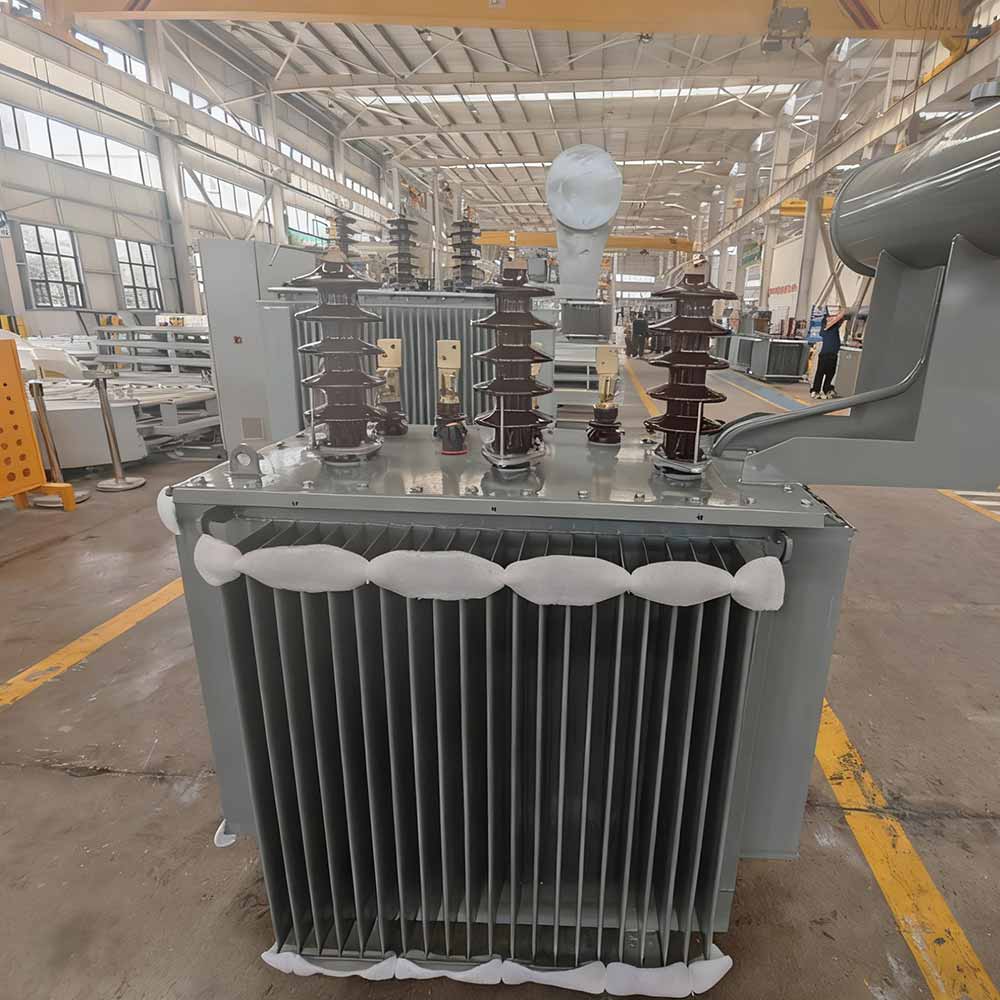
Direct manufacturer relationships deliver multiple advantages for industrial buyers:
Technical consultation: Access engineering expertise during specification development, ensuring optimal transformer selection rather than accepting whatever catalog items suppliers promote.
Customization without compromise: Manufacturers implement genuine engineering modifications—not just selecting from limited pre-defined options.
Warranty clarity: Direct relationships eliminate warranty disputes between equipment manufacturers and intermediary sellers.
Spare parts availability: Original manufacturers stock replacement components for decades; third-party suppliers may not.
Total cost transparency: Understanding the cost drivers (materials, labor, testing) enables more productive price negotiations than negotiating against undisclosed markup structures.
Long-term partnership potential: Industrial facilities require ongoing support. Manufacturers prefer developing strategic relationships over one-time transactions.
الخاتمة
Selecting the right three phase oil immersed المحول requires balancing technical specifications, quality requirements, budget constraints, and long-term operational considerations. The upfront effort invested in proper specification and manufacturer evaluation yields decades of reliable, efficient service.
Key takeaways for your transformer procurement:
- Calculate true load requirements including harmonics and future growth
- Specify efficiency levels appropriate for your utility costs and operating hours
- Verify certifications match your project location and utility requirements
- Evaluate manufacturers on engineering capability, not just price
- Consider total cost of ownership, not just purchase price
Whether you require a standard distribution transformer or a custom-engineered power transformer for a complex industrial application, understanding these fundamentals positions you to make procurement decisions that serve your facility well into the future.
For project-specific guidance on three phase oil immersed transformer selection or to discuss custom transformer requirements, consult with experienced transformer engineers who can analyze your application and recommend optimal solutions.
الأسئلة الشائعة
Q1: What are the main advantages of a three phase oil immersed المحول?
A: It offers high efficiency, excellent cooling performance, overload capacity, and longer service life compared to dry-type transformers. The oil provides both insulation and cooling, making it ideal for heavy-duty industrial applications.
Q2: How do I choose the right kVA rating for my project?
A: Calculate your total load demand, add a 20-25% safety margin for future expansion, and select a capacity that avoids both under-sizing (overloading risk) and over-sizing (wasted investment and lower efficiency).
Q3: What’s the difference between oil immersed and dry type transformers?
A: Oil immersed transformers use mineral oil for cooling and insulation, offering higher capacity and better heat dissipation. Dry type transformers use air or resin, suitable for indoor environments where fire safety is critical but limited in capacity.
Q4: How often should I maintain an oil immersed transformer?
A: Regular oil testing should be conducted annually, with complete oil replacement every 5-8 years depending on operating conditions. Visual inspections and temperature monitoring should be performed monthly.
Q5: What factors affect the price of a three phase oil immersed transformer?
A: Key factors include kVA capacity, voltage rating, material costs (copper, silicon steel, insulating oil), customization requirements, and whether you buy directly from a manufacturer or through a trading company.